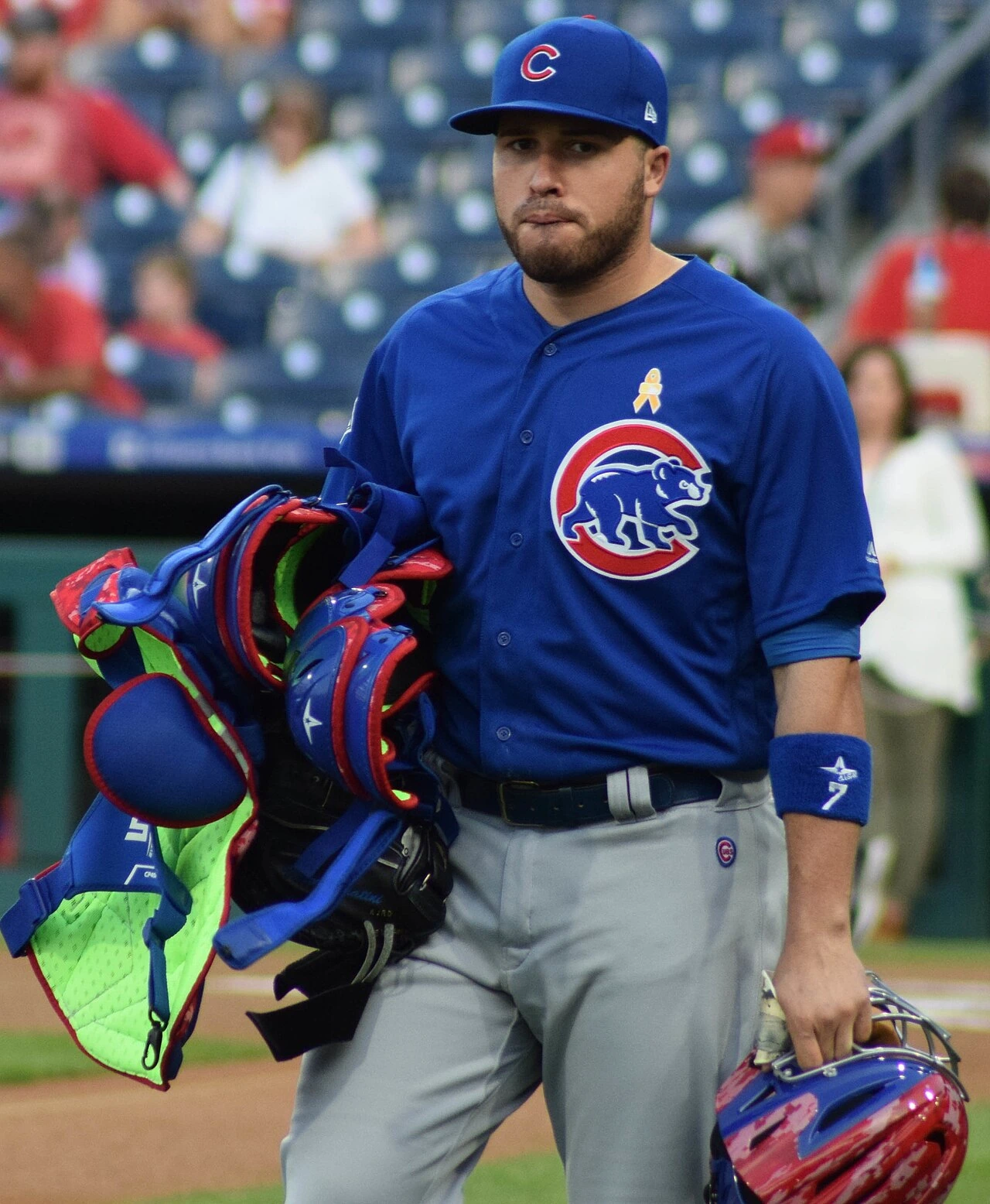
His gross career MLB salary alone, stacking his early pre-arbitration years, his arbitration salaries, his $12 million two-year deal with the Houston Astros (2024–25), and his current two-year, $14 million contract with the Minnesota Twins (2026–27), adds up to well over $25 million in gross earnings. After modeling standard athlete deductions like federal and state income taxes and agent fees, a net-worth figure in the $8–10 million range is a reasonable working estimate based on available public data.
Who is Victor Caratini?

Victor Caratini is a professional MLB catcher born in Puerto Rico. He was drafted by the Atlanta Braves in the second round of the 2013 MLB Draft and received an $800,000 signing bonus at that time. He was later traded to the Chicago Cubs organization, where he made his MLB debut and developed into a reliable backup and occasional starting catcher known for his defense and ability to handle a pitching staff.
After his Cubs tenure, Caratini had stints with the San Diego Padres and Milwaukee Brewers before landing with the Houston Astros and then the Minnesota Twins. By 2026, he had established himself as a veteran MLB catcher commanding multi-year, multi-million dollar contracts, which is the financial foundation underlying any net worth estimate for him.
How net worth gets estimated for an MLB player
Net worth estimates for athletes like Caratini are built from publicly available inputs, not tax filings or bank statements. The main inputs are MLB salary data (base salaries by season, signing bonuses, performance and roster bonuses), any documented endorsement income, and rough assumptions about taxes and spending. Sources like Spotrac, Baseball-Reference, and USA Today's salary database are the most reliable public salary data points. Endorsement income is harder: sites like AthleteAgent list endorsement sections for Caratini, but no verified dollar figures are publicly available. That means endorsement income, if any, is treated as an unquantified upside in the estimate rather than a hard number.
From gross career earnings, you subtract estimated taxes (MLB players pay federal income tax, often state income tax in multiple states where games are played, and sometimes a jock tax in certain cities), agent fees (typically 3–5% of salary under MLB standards), and living expenses over a career. What remains is an approximation of accumulated net worth, which also changes based on whether a player invests wisely, carries debt, or has significant personal expenses. For Caratini specifically, because no private financial disclosures exist, this estimate carries a margin of error of at least a few million dollars in either direction.
Career earnings timeline: contract by contract

Here is a practical breakdown of Caratini's key earnings milestones based on publicly documented contract data. His early MLB seasons (roughly 2017–2020) were spent at or near MLB minimum salary levels, which ranged from about $535,000 to $563,500 per year during that CBA period. His 2021 arbitration cycle with the Cubs pushed his salary up, with projections at the time suggesting a meaningful jump from minimum levels. By 2022, Spotrac lists his base salary at $2,000,000, reflecting his progression through arbitration. Those years represent the foundation of his gross earnings before the big free-agent contracts arrived.
| Period / Contract | Team | Total Value | Annual Average | Notes |
|---|
| 2013 Draft Signing Bonus | Atlanta Braves (draft) | $800,000 | N/A | Signing bonus at draft; traded to Cubs org |
| Pre-arb years (approx. 2017–2020) | Chicago Cubs | ~$535K–$563.5K/yr | ~$550,000 | MLB minimum salary range; estimate based on CBA minimums |
| Arbitration years (approx. 2021–2022) | Chicago Cubs / San Diego Padres / Milwaukee Brewers | ~$2M–$4M total | ~$2,000,000 (2022 documented) | Spotrac confirms $2M base in 2022 |
| 2024–2025 Contract | Houston Astros | $12,000,000 | $6,000,000/yr | Two-year deal; $6M per season; performance bonuses included |
| 2026–2027 Contract | Minnesota Twins | $14,000,000 | $7,000,000/yr | Two-year deal; $14M fully guaranteed; 2026 base salary $4M |
Adding these figures together, Caratini's documented and estimated gross MLB career earnings land somewhere in the $25–28 million range through the end of the 2026 season. The Astros deal confirmed at $12 million over two years and blank" rel="noopener noreferrer">the Twins deal reported at $14 million are the two largest and most verifiable components, cross-referenced across Spotrac, MLB Trade Rumors, and USA Today's salary database, which shows $6,000,000 for individual Astros seasons. Victor Caratini signed a two-year, $14 million deal with the Minnesota Twins, according to Sports Illustrated’s reporting dated Jan. 16 (as cited in the article) the Twins deal reported at $14 million.
Taxes, agent fees, and other factors that shape the real number
Gross earnings and net worth are very different things for an MLB player. A $7 million base salary does not put $7 million in the bank. Baseball-Reference’s salary data for Victor Caratini lists his annual salary as “$7,000,000. 00,” illustrating why gross salary is not the same as cash-in-hand net worth [A $7 million base salary does not put $7 million in the bank.
](https://www. baseball-reference. com/players/c/caratvi01. shtml).
Federal income tax alone can take 37% of income above the top bracket threshold. State and local taxes vary significantly: playing for the Twins in Minnesota means paying Minnesota state income tax (over 9%), but players also owe taxes in other states where they play road games (the jock tax). Agent fees, typically 3–5% of MLB contracts, come off the top as well.
Running a rough model on Caratini's Astros and Twins contracts suggests that combined federal, state, and local taxes plus agent fees could reduce his take-home from those two contracts by 45–50%, leaving him with roughly $13–15 million from those two deals alone before personal expenses.
Investment returns, real estate, and personal spending decisions are where the range widens further. If Caratini has invested consistently, his accumulated wealth could be meaningfully higher than a simple post-tax savings model suggests. If he has significant lifestyle expenditures, family obligations, or has not invested aggressively, it could be lower. These private variables are why comparing his situation to something like Victor Cruz's net worth is instructive: Cruz earned far more in total career NFL money, but his net worth estimates still reflect the impact of taxes, spending, and career length rather than gross earnings alone.
It is also worth noting that career longevity matters enormously. Caratini has had a longer active career than many backup catchers, which has allowed earnings to compound. His signing bonuses across his career, starting with the $800,000 draft bonus and including any bonuses embedded in his Astros deal, add to the total but are still relatively modest compared to his recent base salaries. Athletes in other fields face similar structures: Victor Conte's net worth, for example, reflects how sports-adjacent careers outside direct athlete compensation can produce very different wealth trajectories even within the sports world.
What the estimates don't capture

- Private investment portfolios (stocks, real estate, business ownership) are not publicly disclosed
- Exact agent fee percentage and representation agreements are private
- Endorsement income: AthleteAgent lists an endorsement section for Caratini, but no verified dollar figures are publicly available, so this is modeled as a minor or unknown contribution
- Tax residency and jock tax exposure vary year to year based on game schedules and state rules
- Deferred compensation or contract restructuring terms that may not be publicly detailed
- Personal debt or financial liabilities, which are entirely private
Where to verify the numbers yourself
If you want to cross-check Caratini's salary and contract history, Spotrac is the most detailed public source: it lists his contract breakdown year by year, including base salaries, signing bonuses, and guaranteed amounts. For season-by-season totals, Baseball-Reference's player page provides transaction history and salary data going back to his debut. USA Today's salary database is a solid secondary cross-check for recent seasons. For a quick look at how his current deal compares among catchers, Yahoo Sports published a top-10 highest-paid catchers list for 2025 that included Caratini at $6,000,000 for that season.
For a broader sense of how his wealth might be tracked over time, this site updates athlete estimates as new contract or salary data becomes public. Victor Cibrian's net worth can also be tracked using similar public earnings, contract, and modeling methods, but verified figures are often limited Victor Cibrian net worth. Net worth figures for athletes can shift significantly mid-season if a contract is restructured, a player is released with guaranteed money paid out, or a new deal is signed. Caratini's current Minnesota Twins contract runs through 2027, so the next meaningful update to his earnings picture would come if the Twins exercise any options, if he signs an extension, or when the 2027 offseason produces a new deal.
It is also useful to look at how other athletes' wealth is documented on similar platforms. Victor Costa's net worth page and entries like Victor Carranza's net worth illustrate how this site approaches estimates across different industries, using the same methodology: publicly documented income sources, standard deduction modeling, and clearly labeled estimates rather than presented-as-fact figures. The same transparency applies here.
Putting Caratini's wealth in context
An $8–10 million net worth estimate places Caratini solidly in the upper tier of MLB backup and platoon catchers who have managed sustained careers. He is not in the wealth bracket of a franchise cornerstone player, but he has earned and (if well-managed) retained more than enough to be financially comfortable well beyond his playing days. His career arc, from an $800,000 draft bonus to back-to-back multi-year contracts worth $12 million and $14 million, reflects a player whose market value rose steadily as teams recognized his defensive value and pitching-staff management skills.
For context within this site's broader coverage, his estimated range is higher than many sports-adjacent figures but modest compared to franchise-player athletes. Compare that to something like Victor Ciardelli's net worth in the business world, where wealth accumulation works through entirely different mechanisms, or Victor Cipolla's net worth and Victor Cibrian's net worth, which show how entertainers and professionals outside sports build wealth through different income streams entirely. Caratini's path is straightforwardly contract-driven, which actually makes his estimate more traceable than most.
When to expect this estimate to change
Net worth estimates for active players are moving targets. The most likely triggers for an update to Caratini's figure are: the completion of the 2026 season and confirmation of his full salary paid, any renegotiation or extension with the Twins before the 2027 season begins, or new public information about endorsement deals. If the Twins release him before his contract ends, the guaranteed amount ($14 million for the two-year deal) would still be paid out, which would not change the gross earnings total much but would affect the timeline. Bookmark Spotrac's Caratini page and check back at the start of each MLB season for the most current salary data, and treat any static net worth figure, including the ones on this site, as a snapshot that needs to be refreshed annually.